



Tree planting in Edmonton requires careful species selection, proper planting depth, and realistic watering schedules tailored to our alkaline soil and continental climate. River Valley Tree Trimming has planted hundreds of trees across Edmonton and the surrounding municipalities since 2011, choosing hardy species like sugar maple, red oak, Norway spruce, and black locust that thrive in zone 3b conditions. A newly planted tree needs structural support in exposed locations, correct staking technique, and consistent moisture through the first two growing seasons on our typically dry clay soils. Our ISA Certified Arborists assess your site's exposure, drainage, and microclimate before recommending the right specimen at the right depth. We handle everything from species selection and site preparation through establishment care, ensuring your investment survives in Edmonton and the surrounding area winters and summer heat. Call us at (587) 400-1412 for a free estimate, or visit our contact page to request a consultation.
Why tree planting matters in Edmonton
The Edmonton area loses mature trees to disease, storm damage, and age every year, and replacing them with the right species helps restore canopy cover, property value, and neighbourhood character. Many ravine lots and post-war subdivisions have thin soils and poor drainage that demand careful species matching. Newly planted trees also provide privacy screening, windbreaks, and shade in tight backyards where mature specimens may be unreachable or too large. Planting at the correct depth prevents collar rot and girdling roots, two common failures that kill young trees within five years. Our arborists select only cold-hardy species proven to survive Edmonton winters and the freeze-thaw cycles that damage shallow roots and frost-cracked bark.
- Choose species rated for zone 3b and our alkaline clay soils, such as sugar maple, red oak, or Norway spruce.
- Plant in autumn dormancy or early spring when soil moisture is reliable and transplant shock is minimal.
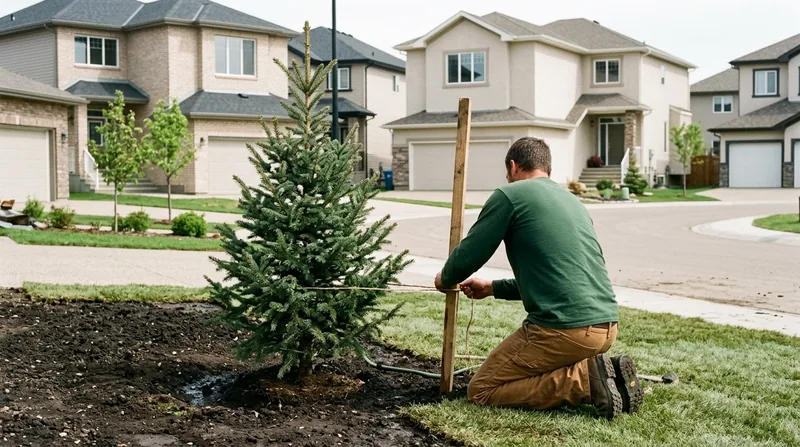
- Stake trees in exposed locations to prevent wind rock and root damage during establishment.
- Water consistently through the first two growing seasons, especially during dry spells on our naturally drained upland sites.
- Apply mulch 5 to 10 centimetres deep around the root zone to retain moisture and regulate soil temperature.
- Avoid planting near underground utilities, septic fields, or areas prone to standing water after snowmelt.
These steps ensure your new tree becomes a long-lived asset rather than a failed investment.
Local insight: A 50-millimetre diameter sugar maple planted at the correct depth in Glenora or Westmount costs between $400 and $800 installed, including staking and initial mulch. Larger specimens (75 to 100 millimetres) run $1,200 to $2,000. Soil amendment for alkaline clay may add $150 to $300 depending on area and depth of preparation.
How we plant trees in the Edmonton area
Our process begins with a site assessment to evaluate sun exposure, wind load, soil drainage, and proximity to structures or utilities. We then recommend species suited to those conditions and source healthy nursery stock from suppliers who specialize in cold-hardy cultivars. Planting depth is critical: the root flare must sit just above grade, never buried, to prevent collar rot. We backfill with amended soil if your native clay is severely compacted, stake the tree in exposed locations using flexible ties that allow trunk movement, and apply mulch to stabilize moisture. Watering instructions are provided in writing so you understand the commitment through the first two seasons.
- Evaluate site conditions including sun, wind exposure, soil type, and drainage patterns.
- Select and source a nursery-grown specimen matched to zone 3b hardiness and your soil chemistry.
- Prepare the planting hole to a depth equal to the root ball height, never deeper.
- Position the tree so the root flare sits at or just above finished grade.
- Backfill with native soil amended only if clay is severely compacted or alkalinity is extreme.
- Install stakes and flexible ties if the tree is taller than 3 metres or the site is exposed to prevailing winds.
- Apply 5 to 10 centimetres of wood chip mulch, keeping it 10 centimetres away from the trunk to prevent rot.
- Provide written watering and care instructions for the establishment period.
This methodical approach minimizes transplant shock and gives your tree the best chance to establish a deep, fibrous root system before its first harsh winter.
Example: A homeowner in Crestwood with compacted clay and afternoon sun exposure chose a 60-millimetre red oak for privacy screening. We amended the planting hole with compost, staked the tree for three years, and the client watered deeply twice weekly through the first summer. By year three, root establishment was solid and the tree required only seasonal moisture. Total investment was $650 installed, plus $80 annually for mulch renewal during the first two seasons.
| Planting Method | Description | Best For |
|---|---|---|
| Bare-root planting | Tree dug dormant, roots bare, planted in spring or autumn. Lightest cost, highest transplant shock if delayed. | Budget-conscious projects, early spring or late autumn installation. |
| Root-ball planting | Tree dug with soil around roots, wrapped in burlap or fabric. Moderate cost and transplant shock, year-round planting possible. | Most Edmonton residential projects, especially larger specimens. |
| Container planting | Tree grown in a pot, roots are contained. Highest cost, lowest transplant shock, can plant spring through autumn. | Premium installations, tight timelines, or when bare-root supply is limited. |
| Soil amendment | Native clay mixed with compost, peat, or sand to improve drainage and reduce alkalinity. Adds $150 to $400 depending on hole size. | Compacted sites, severely alkaline soils, or when drainage is poor after spring snowmelt. |
Species selection for Edmonton neighbourhoods
The right tree for Edmonton is not the right tree for Toronto or Vancouver. Our continental climate, alkaline clay, and short growing season demand species with proven cold hardiness and drought tolerance once established. Sugar maple and red oak are classic choices for shade and fall colour, thriving in well-drained upland sites across Edmonton and St. Albert. Norway spruce and white spruce offer windbreak and privacy screening in exposed locations. Black locust tolerates poor soil and compaction better than most broadleaves, making it ideal for street-facing yards or parking areas. Avoid species like silver maple, which splits in freeze-thaw cycles, or European white birch, which struggles in our dry alkaline soils. Our certified arborists match each site's sun, wind, soil, and drainage profile to a species with the best chance of 50-year survival.
- Sugar maple thrives in well-drained upland sites and offers dense shade and reliable fall colour in Edmonton's zone 3b.
- Red oak grows slowly but steadily in our clay, providing excellent shade and a strong branching structure resistant to storm damage.
- Norway spruce handles wind exposure and poor drainage better than most conifers, making it suitable for ravine lots and windswept properties.
- Black locust tolerates compacted soil and alkalinity, ideal for difficult sites where other species fail.
- White spruce is native to in Edmonton and the surrounding area, extremely cold-hardy, and suitable for shelterbelts or tall screens on exposed ground.
- Avoid silver maple, which splits under freeze-thaw stress, and European white birch, which declines in our dry, alkaline conditions.
A site visit by one of our arborists costs nothing and takes 15 minutes. We assess your soil, exposure, and long-term vision, then recommend one or two species with the highest survival rate for your exact location.
Watering and aftercare in Edmonton
Newly planted trees in Edmonton require consistent moisture through the first two growing seasons, but not waterlogged soil. Our alkaline clay drains slowly, so overwatering is a common mistake that kills roots faster than drought. Water deeply once or twice weekly during the growing season, aiming for 2.5 to 5 centimetres of moisture per week, including rain. During the second season, reduce frequency but maintain depth, encouraging roots to grow downward in search of moisture. Mulch keeps soil cooler, reduces evaporation, and moderates temperature swings that damage young bark. After two years, most trees are established enough to rely on seasonal rainfall, though summer drought may still require supplemental watering during dry spells. We provide written care instructions with every planting, and you can always call us at (587) 400-1412 if questions arise.
- Water deeply once or twice weekly during the growing season, delivering 2.5 to 5 centimetres per week including rainfall.
- Check soil moisture by digging 10 centimetres deep; it should be moist but not soggy.
- Reduce watering frequency in the second season to encourage deep root development.
- Maintain 5 to 10 centimetres of wood chip mulch year-round, keeping it 10 centimetres away from the trunk.
- Renew mulch annually in spring to replace decomposed material and maintain moisture regulation.
- Prune broken branches or crossing limbs in the first three years to establish a strong framework, but avoid heavy pruning.
- Monitor for pests, disease, or signs of stress (yellowing leaves, dieback) and contact us if problems develop.
This simple routine turns a young tree into a healthy, long-lived specimen that survives Edmonton winters and provides decades of benefit.
Permits and site preparation
Tree planting itself does not require a municipal permit in Edmonton, but your site may have constraints worth knowing. If you are planting near a private electrical service entrance (the wire from the pole to your house), we observe safe approach distances and never work on the public distribution network operated by your local utility or AltaLink. Underground utilities including gas, water, and telecom lines must be marked before any digging occurs; call 811 in Edmonton and the surrounding area Locates free of charge at least three business days before work. If your lot is steep, in a ravine, or on a property line, we assess drainage and root zone space to ensure the tree thrives long-term. Soil testing is optional but valuable if you suspect extreme alkalinity or compaction; a simple soil pH test costs $50 to $100 and guides species selection.
River Valley Tree Trimming is a fully insured local company operating in Edmonton and the surrounding municipalities since 2011. We carry comprehensive liability coverage and hold ISA Certified Arborist credentials. Call (587) 400-1412 to schedule your free estimate, or visit our pricing page for a snapshot of typical costs. For details on all our service areas, see our service areas page. If you are also considering tree removal or pruning work on existing trees, we offer tree removal and tree pruning and crown reduction as well.
Prices Tree Planting in Edmonton — Indicative pricing
| Service | Price | Details |
|---|---|---|
| Small tree planting (50 mm diameter) | From $400 | Species selection, site prep, planting, staking, mulch, and initial care instructions included. |
| Medium tree planting (60–75 mm diameter) | From $650 | Larger specimen, amended soil, staking for exposed sites, and a two-season watering plan. |
| Large tree planting (90–100 mm diameter) | From $1,200 | Premium nursery stock, deep soil amendment, multi-year staking, and detailed establishment care. |
| Soil amendment and preparation | From $150 | Clay improvement, compost incorporation, drainage assessment, and pH testing. |
| Free estimate | Free | Site visit, species recommendation, and written planting plan. Call (587) 400-1412. |
| Travel and equipment | Included | All sites in Edmonton and the surrounding municipalities. |
Indicative prices; free, personalized estimate within 24h at (587) 400-1412.