



Tree cabling and bracing in Edmonton keeps mature trees standing when their structure fails. Heavy wet snow on leafed-out branches, windstorms, and the weight of age weaken scaffold limbs and create unions that split under load. Rather than fell a 50-year-old American elm or green ash that anchors your streetscape, we install flexible steel cables and bracing systems to support weak crotches and cracked limbs. River Valley Tree Trimming has used this technique since 2011 to preserve heritage and specimen trees across the Edmonton area. Our ISA Certified Arborists assess the risk, design the system, and install it so the tree continues to grow and move naturally. If your tree shows signs of failure—bark sealing a crack, limbs hanging at odd angles, or visible splits in the crotch—a free estimate will show whether cabling is the answer or removal is safer.
Why cabling and bracing matters in Edmonton neighbourhoods
Edmonton's older streets are lined with American elm, green ash, and trembling aspen planted when the neighbourhood was laid out. These trees have reached full maturity, and their wood becomes brittle in our climate. A heavy, wet snow in late spring, when leaves have already emerged, can snap a major limb or crack a weak crotch. Summer windstorms push crowns hard, and frost cycles in our deep cold make old wood more prone to failure. Removing a structurally sound tree just because one limb is weak wastes decades of growth and the shade, privacy, and wildlife value it provides. Cabling and bracing buy time, stabilise the tree, and let it live another 20 or 30 years.
- Prevents a weak crotch or cracked scaffold limb from splitting under snow or wind load.
- Reduces risk to structures, vehicles, and pedestrians without removing the tree.
- Preserves mature trees that anchor the character of older neighbourhoods.
- Works on American elm, green ash, paper birch, and other heritage species.
- Can be combined with pruning to lighten the crown and reduce wind resistance.
Cabling is most effective when installed before the tree fails catastrophically. Once a major limb has cracked or a crotch has begun to split, the structural integrity is already compromised, and we assess whether bracing can still help or removal is the safer choice.
Local example: A 55-year-old American elm in Glenora with a 60-centimetre-wide crotch and a visible radial crack cost $1,850 to cable and brace. Without intervention, removal would have run $2,400 to $3,200. The tree is now stable, and the homeowner kept their street tree.
How we install cabling and bracing
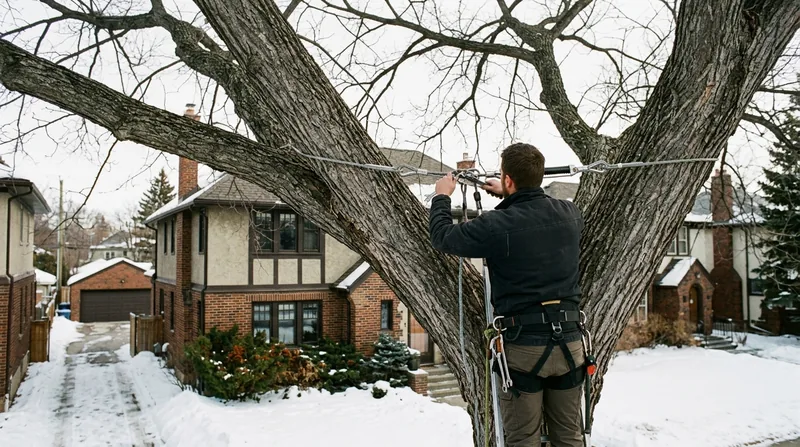
Our process begins with a detailed inspection. We climb or use a bucket truck to examine the weak union, measure limb diameter, assess crown weight, and identify the exact points where cables need to anchor. We photograph the damage and explain our findings on site. Then we design a system tailored to that tree, not a one-size-fits-all approach. We use high-strength steel cable, forged hardware rated for the load, and installation methods that do not girdle or damage bark. The cables run from a strong upper limb or the main stem down to a lower limb or the trunk, supporting the weak crotch without restricting the tree's natural movement.
- We inspect the tree for crack depth, wood decay, and limb angle to determine cable placement.
- We select cable diameter and hardware based on limb weight and the span to be supported.
- We install cables with proper tension, leaving enough slack so the tree can sway in wind.
- We may prune crossing limbs or reduce crown weight to lower the load on the weak union.
- We photograph the finished work and provide written documentation for your insurance file.
The entire process typically takes 2 to 4 hours for a single tree, depending on height, access, and complexity. We clean up all debris and haul away any pruned wood. For trees near power lines, we maintain safe approach distances and refer any work on the public distribution network to your local utility or AltaLink.
Concrete case: A green ash in Fort Saskatchewan with two major limbs at a 45-degree angle and a history of ice damage received cable bracing in November (dormant season). Cost was $1,600. The homeowner documented the work for their insurer and avoided a $3,000 removal.
Cabling methods and materials
| Method | Description | Best for |
|---|---|---|
| Single cable (two-point) | Steel cable runs from one strong limb to another, supporting a weak crotch between them. | Limbs of similar diameter with a single point of weakness. |
| Multiple cables (three or more points) | Two or more cables distribute the load across several anchor points, reducing stress on any one limb. | Large crowns, multiple weak crotches, or limbs of unequal size. |
| Brace rod (rigid) | A steel rod connects two limbs with no slack, holding them at a fixed angle. | Young trees with a newly forming weak crotch, or trees where limb movement is not desired. |
| Combined cable and prune | We cable the weak union and remove crossing limbs or thin the crown to reduce overall load and wind resistance. | Mature trees with dense foliage or multiple structural issues. |
All hardware is stainless steel or galvanised to resist in Edmonton and the surrounding area's freeze-thaw cycles and black soil chemistry. Cables are rated for the load and installed with proper turnbuckles so tension can be checked and adjusted each year. We do not over-tighten, which would restrict the tree's natural sway and create stress points.
Timing and regulatory context in the Edmonton area
Structural cabling is best done in dormancy (late fall to late winter), when the tree is not in active growth and we can assess the full extent of damage. If the tree is an elm, provincial rules ban pruning from April 1 to September 30, so any cabling work must occur outside that window. For trees on private property in the Edmonton area, municipal rules vary by location, and we check the requirements for your specific address. If your tree is on a boulevard or public land, only the City of Edmonton may work on it. We document all work with photos and measurements so you have a record for your insurance file.
For trees near private electrical service entrances, we maintain safe approach distances. If a tree or limb is in contact with the public distribution network operated by your local utility or AltaLink, we refer that work to the utility; we do not work on those lines. Our role is to stabilise the tree on your property and keep it clear of hazards.
A free estimate from one of our ISA Certified Arborists will clarify whether cabling is viable for your tree, what the system will cost, and when the best time to install it is. Call (587) 400-1412 or visit our contact page to request an appointment. We serve Edmonton, St. Albert, Strathcona County, Fort Saskatchewan, Leduc, Spruce Grove, Stony Plain, Devon, Morinville, and the surrounding municipalities. For more information on how we assess tree health and risk, see our arborist report service. If you are considering whether to cable or remove, our tree removal page outlines when removal is the safer choice. And if your tree has been damaged by heavy snow or wind, our emergency storm cleanup service is available 24/7.
Prices Tree Cabling & Bracing in Edmonton — Indicative pricing
| Service | Price | Details |
|---|---|---|
| Single-cable installation (one weak crotch) | From $1,200 | Includes inspection, cable, hardware, and installation on trees up to 15 metres tall. |
| Multi-cable system (two or more weak points) | From $1,800 | Multiple cables, larger crown, or complex geometry. Detailed risk assessment included. |
| Brace rod (rigid support) | From $950 | For young trees or where fixed-angle support is required. Single point connection. |
| Cable plus crown reduction | From $2,200 | Cabling combined with pruning to reduce wind load and improve structure. |
| Large tree or difficult access | On estimate | Bucket truck, rope access, or complex rigging. Free site assessment. |
| Free estimate | No charge | Response within 24 hours. Call (587) 400-1412 or request online. |
Indicative prices; free, personalized estimate within 24h at (587) 400-1412.