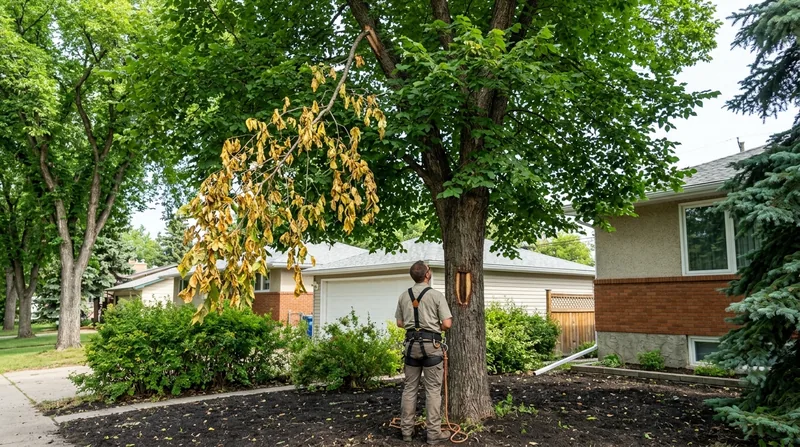




Dutch Elm Disease Assessment in Edmonton is essential for protecting one of the largest healthy stands of American elm left anywhere in North America. Our ISA Certified Arborists evaluate your tree's health, explain the provincial pruning ban that runs from April 1 to September 30, and show you exactly what the rules require for safe removal or pruning. Heavy wet snow, drought stress and frost crack your elms' limbs every winter; we assess the damage and plan the right response.
Edmonton's river-valley lots and older neighbourhoods are lined with mature American elms that define the streetscape. Each one matters. We have been assessing and managing elms in the Edmonton area since 2011, and we know how to read the signs of stress, disease risk and structural weakness. A free estimate takes 30 minutes and gives you the facts you need to decide.
Why Dutch Elm Disease Assessment Matters
American elms are susceptible to Dutch elm disease, a fungal infection spread by bark beetles. in Edmonton and the surrounding area has kept the disease out so far, but vigilance is the only reason. Proper pruning removes dead and diseased wood before beetles lay eggs in it. Improper pruning, or storing elm wood on your property, can invite trouble. Our assessment tells you which branches are truly at risk and which can stay.
We also check for the physical stresses that weaken elms in this climate:
- Heavy snow loading on weak crotches and co-dominant stems splits limbs apart.
- Drought and salt from roads thin the crown and expose bark to frost crack.
- Competing leaders create structural defects that fail under wind or ice.
- Dead wood in the canopy is a beetle magnet and a liability.
Our assessment identifies which of these problems your elm faces and what pruning or removal will solve them safely and legally.
Local example: An American elm in Glenora with a 60 centimetre diameter and heavy snow damage on the south side costs $375 to $525 for a full structural assessment and written report. A smaller tree with light damage assessment runs $225 to $350. We document everything for your insurer if you need it.
How We Assess Your Elm
Our process is straightforward and thorough. We climb into the canopy, test limb strength, check for disease signs, and measure the tree's lean and crown balance. We take photos and notes, then sit down with you to explain what we found and what action makes sense.
The assessment covers these key areas:
- We examine the trunk and major limbs for cracks, cavities, cankers and bark damage that signal disease or structural failure.
- We test branch attachment angles and identify co-dominant stems or crossing limbs that will fail.
- We assess crown density, branch distribution and lean to predict wind resistance.
- We map dead wood and recommend removal or pruning to reduce beetle habitat.
- We check the tree's proximity to your house, garage, power lines and neighbouring properties to identify risk areas.
Once the assessment is complete, we give you a clear recommendation: prune now to extend the tree's life, remove it safely, or monitor it and reassess in two years. We also explain what the provincial elm pruning ban means for your timeline.
Real scenario: A homeowner in Fort Saskatchewan has a 45-year-old American elm with a large horizontal limb over the back deck. The limb shows bark damage from last winter's snow load. Our assessment costs $275, takes 45 minutes, and includes a written report with photos. We recommend removing that one limb now (late November through March, outside the ban window) and monitoring the rest of the crown. If the homeowner wants the whole tree removed, we provide a separate quote for that work.
Assessment Methods and What They Tell Us
We combine visual inspection with hands-on testing to build a complete picture of your elm's health and safety.
| Method | What We Learn | When We Use It |
|---|---|---|
| Crown inspection from ground and canopy | Dead wood, branch structure, disease signs, overall balance | Every assessment; we climb to reach high limbs |
| Bark and wood examination | Cracks, cavities, cankers, discolouration that signal fungal infection | Standard on all elms; critical for disease risk |
| Branch strength testing and crotch angles | Failure risk; which limbs are weak and will drop | When we see snow damage, cavities or narrow angles |
| Documented report with photos and recommendations | Written proof for insurance, permit applications or future reference | Always included; you take it away |
The report we provide is suitable for insurance claims and can support a removal or pruning permit application with your municipality if one is required. We check the rules for your address and explain what paperwork, if any, you will need.
Provincial Rules and Timing
in Edmonton and the surrounding area's elm pruning ban runs from April 1 to September 30 every year. During this window, elm wood cannot be pruned, removed, transported or stored anywhere in the province. The ban exists to prevent the spread of Dutch elm disease by bark beetles, which are active during the warm months. If your elm needs pruning or removal, we schedule that work between October 1 and March 31.
For trees on private property, local municipal rules may also apply. We check those rules for your address and tell you whether a permit is required before we start. The City of Edmonton manages all trees on public land and boulevards, so if your elm is on the street boulevard, the municipality handles any pruning or removal.
Our assessment includes a clear explanation of these rules and how they affect your tree. We also document the condition of your elm so that if you need to apply for a permit later, you have professional evidence to support your application. Call us at (587) 400-1412 or visit our contact page to book your free estimate today.
For more detail on how we handle elm pruning during the legal window, see our elm pruning service page. If your elm shows signs of disease or severe damage and needs removal, we offer complete tree removal and can coordinate the timing to comply with provincial rules.
After Your Assessment
Once we complete the assessment, you have several options. If pruning is recommended, we can schedule that work in the dormant season (late fall through late winter) and outside the April 1 to September 30 elm ban. If removal is the best choice, we handle that as a separate project and grind the stump if you wish. If the tree is healthy and only needs monitoring, we note that in your report and you can call us back in a year or two for a follow-up look.
We also handle full arborist reports and risk assessments if you need a detailed document for insurance, legal or real estate purposes. A comprehensive report costs more than a quick assessment but gives you a professional opinion suitable for formal proceedings.
River Valley Tree Trimming has been serving Edmonton and the surrounding municipalities since 2011. We are fully insured, and our ISA Certified Arborists bring field expertise to every job. Contact us today for your free estimate.
Prices Dutch Elm Disease Assessment in Edmonton — Indicative pricing
| Service | Price | Details |
|---|---|---|
| Standard Dutch Elm Disease Assessment | From $225 | Includes visual inspection, branch testing, and basic written summary for trees up to 15 metres tall |
| Comprehensive Assessment with Report | From $375 | Full canopy inspection, detailed documentation, photos, and written recommendations suitable for insurance or permits |
| Large or Complex Tree Assessment | From $525 | Trees over 20 metres, multiple hazards, or structural concerns requiring extensive analysis |
| Follow-up Assessment (12 months) | From $175 | Reassessment of a previously evaluated elm to track changes and update recommendations |
| Travel and Access | Included | No charge for travel within Edmonton and the surrounding area |
| Free Estimate | Free | Call (587) 400-1412 or contact us online for a no-obligation assessment quote |
Indicative prices; free, personalized estimate within 24h at (587) 400-1412.