



Trees across Edmonton and the surrounding municipalities face constant stress from heavy black soil, late-spring frost, windstorms and the weight of wet snow on leafed-out crowns. When a mature American elm, green ash or spruce shows signs of structural weakness, disease or hazard, an arborist report and risk assessment becomes essential for insurance claims, property sales, neighbour disputes and construction permits. River Valley Tree Trimming, staffed by ISA Certified Arborists since 2011, delivers detailed written documentation that protects your property and clarifies liability. We examine the tree's health, structural integrity and proximity to structures, utilities and people, then provide a professional report you can present to your insurer, municipality or legal counsel.
Why a professional assessment protects your property
A tree touching a rear-lane garage, leaning toward a neighbour's fence or showing crown dieback may carry hidden risk. Without a written assessment from a certified arborist, you have no baseline for liability, no documentation for your insurance file and no clear path to remediation. The City of Edmonton manages trees on public boulevards, but private trees are your responsibility. A formal report establishes what the tree's condition was on the date of inspection, identifies specific hazards and recommends action. This document holds weight in insurance disputes, property transactions and legal proceedings.
- We conduct a hands-on inspection of crown structure, root collar, lean and branch attachment angles.
- We photograph and document visible defects, pest damage, disease symptoms and decay pockets.
- We assess proximity to structures, fences, utility lines and pedestrian areas.
- We rate the tree's hazard level and recommend monitoring or removal.
- We provide a written report suitable for insurance, legal and municipal files.
This assessment gives you certainty and a defensible record.
Real example: A homeowner in Glenora discovered a 40-year-old green ash with significant crown thinning and a 20-degree lean toward the house. An arborist report documented the hazard, allowing the owner to claim tree removal on insurance and negotiate with the neighbour whose property was also at risk. Without the report, the claim would have been denied.
How we document tree risk in Edmonton
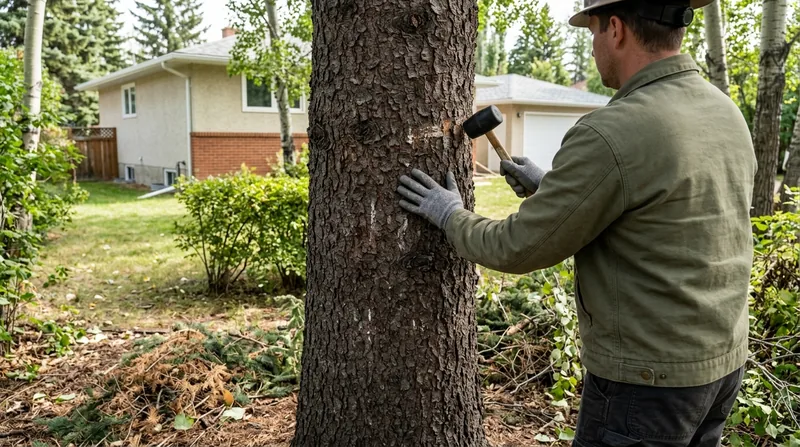
Our ISA Certified Arborists follow a systematic process to evaluate each tree's condition and the specific risks it poses to your property. We begin with a visual inspection from the ground, looking for crown shape, branch angles, bark damage and signs of decay or disease. For trees over 15 metres or showing advanced decline, we may use climbing inspection to examine the upper crown and branch unions more closely. We measure lean, assess root collar condition and check for proximity hazards around structures, driveways and utility lines.
- We climb if needed to inspect branch unions and upper crown condition for hidden defects.
- We document lean angle, root collar exposure and signs of root damage or soil compaction.
- We identify insect damage, fungal fruiting bodies and disease symptoms specific to the species.
- We measure distances to structures, fences, power lines and neighbouring property.
- We assign a hazard rating (low, moderate, high) with specific risk factors.
- We provide written recommendations for monitoring, pruning, cabling or removal.
The final report is a professional document you can share with your insurance company, municipality or legal counsel.
Common Edmonton scenario: A trembling aspen in Westmount with significant suckering at the base and brittle upper limbs overhanging a deck. Assessment cost is $285, but the report allows the homeowner to prove the hazard and obtain insurance approval for removal before a storm causes injury or property damage.
Assessment methods and report formats
| Assessment Type | What We Examine | Best For |
|---|---|---|
| Visual ground inspection | Crown shape, branch angles, bark condition, lean, root collar, proximity to structures. | Standard hazard assessment, insurance claims, property transactions. |
| Climbing inspection | Upper crown, branch unions, hidden decay pockets, cavity extent, wood density testing. | Tall or complex trees, advanced decay, high-value property, legal disputes. |
| Disease and pest diagnosis | Fungal fruiting bodies, canker spread, insect galleries, leaf symptoms, host suitability. | Dutch elm disease, crown dieback, neighbour disputes over tree health. |
| Post-damage assessment | Broken branches, root damage, soil compaction, crown recovery potential after storm or snow load. | Insurance documentation after windstorm, heavy snow or equipment damage. |
Each report includes photographs, measurements, hazard rating and a professional recommendation. We deliver the document within three business days, formatted for insurance, legal and municipal use.
Municipal rules and utility clearance in the Edmonton area
The City of Edmonton manages public boulevard trees, and only the municipality may prune or remove them. For trees on your private property, rules vary by municipality in the surrounding area, so we check the specific requirements for your address before proceeding. If your tree is near your private electrical service entrance (the wire from the pole to your house), we maintain safe approach distances and never work on the public distribution network operated by your local utility or AltaLink. A tree already touching utility lines is referred directly to the utility for assessment and clearance. Our report clearly documents proximity to utilities and structures, helping you understand what work is safe and what requires utility involvement.
For trees on river-valley or ravine lots across Edmonton, access and soil conditions are part of our assessment. We also note any elm trees subject to the provincial pruning ban from April 1 to September 30, which applies everywhere in in Edmonton and the surrounding area. Our report respects all these constraints and guides your next steps clearly.
Contact River Valley Tree Trimming at (587) 400-1412 for a free estimate. Visit our contact page to request an arborist assessment, or explore our other services including tree removal and tree disease diagnosis. We serve Edmonton, St. Albert, Strathcona County, Fort Saskatchewan, Leduc, Spruce Grove, Stony Plain, Devon, Morinville and surrounding municipalities. For detailed pricing and service areas, see our pricing page and service areas.
Prices Arborist Report & Risk Assessment in Edmonton — Indicative pricing
| Service | Price | Details |
|---|---|---|
| Visual ground assessment | From $235 | Standard hazard inspection, photographs and written report for insurance or property transaction |
| Climbing inspection with detailed analysis | From $385 | Upper crown examination, cavity assessment and advanced decay evaluation for complex or high-value trees |
| Post-storm or damage assessment | From $310 | Emergency documentation of broken branches, root damage or soil compaction for insurance claims |
| Disease and pest diagnosis report | From $285 | Identification of Dutch elm disease, canker, fungal issues or insect damage with treatment recommendations |
| Travel | Included | No extra charge within Edmonton and the surrounding area. |
| Free estimate | Free | Call (587) 400-1412 to discuss your tree and receive a no-obligation quote |
Indicative prices; free, personalized estimate within 24h at (587) 400-1412.