



Trees across Edmonton show signs of disease and stress for many reasons: drought stress on green ash, frost crack on white spruce, root collar damage from soil compaction, canker diseases on poplar and aspen, or the slow decline that follows heavy wet snow damage to the crown. A tree disease diagnosis in Edmonton begins with a trained eye on site, examining what the tree can recover from and what has to come out. River Valley Tree Trimming sends ISA Certified Arborists to assess the condition, rule out the salvageable from the hazardous, and give you a clear action plan. We have worked across Edmonton and the surrounding municipalities since 2011, reading the health of American elm, green ash, spruce, aspen and birch in our climate. This service protects your property, clarifies your options and often saves a tree that looks beyond hope.
Why tree disease diagnosis matters in Edmonton
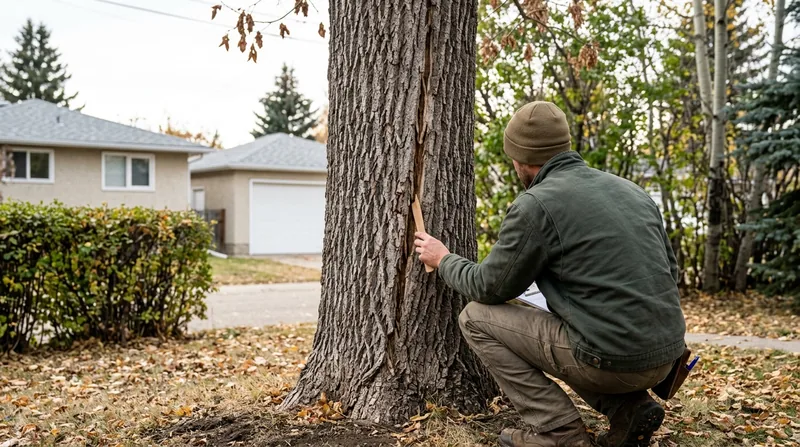
A declining tree is not always a dead tree. The difference between removal and recovery often comes down to a professional assessment on the ground. In Edmonton, where heavy black soil and clay drainage patterns stress roots, where late spring frost can split sapwood, and where deer and salt damage the lower trunk, a tree may look terminal but still have years ahead. Our arborists examine the crown for density and colour, check the bark for cankers and splits, inspect the root collar for girdling or sunscald, and assess visible roots for rot or compaction damage. We then tell you what stays and what goes, backed by decades of experience with local species.
- We inspect the crown structure, branch attachment and signs of disease or insect damage.
- We probe the root collar and base for decay, girdling roots or soil damage.
- We assess structural risk and the tree's capacity to compartmentalize wounds.
- We recommend treatment, cabling, removal or monitoring based on what we find.
- We document findings in writing so you have a record for your insurance or the City of Edmonton if a permit is required.
The result is a clear diagnosis and a path forward, not guesswork or unnecessary removal.
Local insight: Green ash trees in Edmonton neighbourhoods often show crown thinning from drought, salt and frost damage. An arborist diagnosis can tell whether the tree will recover with pruning or whether removal is the safer choice. We have assessed hundreds of ash across the city and surrounding areas.
How we diagnose tree disease and decline
The process is straightforward and happens on your property. Our certified arborist arrives with tools to measure, probe and observe. We look at the whole tree from ground to crown, take photographs, and ask about history: when did you notice the problem, has there been recent construction or grade change, did it follow a storm. We then give you our assessment verbally on the spot, answer your questions, and provide a written report if you need it for your records or for the City of Edmonton.
- We examine the crown from all sides, noting branch angles, taper and signs of disease.
- We check bark texture, colour and the presence of cankers, splits or insect galleries.
- We probe the root collar with a tool to test for soft wood and hidden decay.
- We ask about the tree's history and any changes you have noticed in the past few years.
- We provide a written opinion with recommendations and discuss next steps on site.
If removal is needed, we can provide a quote for that work. If pruning or cabling will help, we discuss timing and cost. If monitoring is the answer, we explain what to watch for.
Real example: A homeowner in Glenora noticed their 40-year-old American elm had sparse foliage and large dead branches. Our diagnosis found frost cracks in the trunk and root collar damage from a utility trench, but the tree was still compartmentalizing. We recommended targeted pruning and monitoring rather than removal. Two seasons later, the crown has recovered and the tree is stable.
Assessment methods and what we look for
| Assessment Method | What We Check | Why It Matters |
|---|---|---|
| Crown inspection | Canopy density, branch angles, dead wood, colour and foliage distribution. | Crown condition reveals the tree's ability to photosynthesize and compartmentalize wounds. |
| Bark and trunk examination | Cankers, splits, frost cracks, sunscald, insect galleries and oozing. | Bark damage often signals internal decay or environmental stress that will worsen over time. |
| Root collar assessment | Girdling roots, sunscald, soil compaction, root flare visibility and decay. | Root collar damage is often hidden but critical; it affects nutrient and water flow to the entire tree. |
| Probe testing | Soft wood, hollow sections and internal decay in the trunk and root collar. | Decay depth determines whether the tree can safely support its own weight and withstand wind. |
| Risk assessment | Proximity to structures, branch size, lean and likelihood of failure in wind or snow load. | A declining tree near a house or garage poses a liability; diagnosis clarifies whether it must be removed. |
| Documentation | Photographs, measurements and written findings for your records and insurance claim. | Written reports support permit applications to the City of Edmonton and help insurers understand the situation. |
When to call for a tree disease diagnosis in the Edmonton area
You do not need to wait until a tree is obviously dying. Early diagnosis catches problems before they worsen and often opens up options that later become impossible. Call us if you notice sparse foliage, large dead branches, bark damage, a sudden lean, oozing or pest activity. We also diagnose trees after storm damage, heavy wet snow, or construction work nearby. Our certified arborists can distinguish between normal seasonal change and genuine decline, saving you money and worry.
- The crown is noticeably thinner than it was a year or two ago.
- Large branches are dead or dying while the rest of the tree looks healthy.
- The trunk has visible cracks, cankers, oozing or large sections of missing bark.
- The tree has a new lean or the root collar is exposed or sunken.
- You see sawdust, galleries or other signs of insect damage on the trunk or branches.
- The tree is near power lines or structures and you want to know if it is safe to keep.
Early action often costs less and gives better outcomes than waiting for the problem to become critical.
Regulatory requirements and documentation
Tree disease diagnosis is not regulated, but the actions that follow may be. If your tree is on a boulevard or public property, only the City of Edmonton can remove or prune it. If the tree is on your private land, the rules depend on your municipality, so we check before recommending work. If we find that the tree poses a hazard and must be removed, we can provide a written report to support a permit application or an insurance claim. We document our findings with photographs and measurements, giving you a clear record of the tree's condition on the date of assessment. For trees near your private electrical service entrance, we respect safe approach distances and refer any work on public utility lines to your local utility or AltaLink.
Our assessment stands as a professional opinion backed by our ISA Certified Arborist credentials and our experience across Edmonton since 2011. We work with homeowners, property managers and insurance adjusters to provide the clarity needed to make informed decisions about tree care.
Next steps after your diagnosis
Once we have assessed your tree, the path forward depends on what we find. If the tree is healthy or recovering, we may recommend monitoring or targeted pruning to improve structure. If disease or decay is present but the tree is stable, we discuss treatment or management options. If the tree is hazardous or in decline beyond recovery, we recommend removal and can provide a quote for that work. We also offer tree pruning and crown reduction to improve health and structure, tree cabling and bracing to support weak limbs or forks, and detailed arborist reports if you need formal documentation for your records or the City of Edmonton. Contact us at (587) 400-1412 or visit our contact page to request a free estimate and schedule your on-site assessment today.
Prices Tree Disease Diagnosis in Edmonton — Indicative pricing
| Service | Price | Details |
|---|---|---|
| Tree disease diagnosis on site | From $145 | Certified arborist assessment, crown and root collar inspection, written opinion and recommendations. |
| Diagnosis with formal arborist report | From $245 | Full written report with photographs, measurements and documentation for insurance or permit applications. |
| Multiple trees or large property assessment | From $395 | Comprehensive survey of three or more trees with prioritized recommendations and risk ranking. |
| Emergency or urgent diagnosis | From $175 | Same-day or next-day assessment for trees posing immediate risk after storm damage or sudden decline. |
| Travel within Edmonton area | Included | No additional charge for service calls in Edmonton and surrounding municipalities. |
| Free estimate | Complimentary | Call (587) 400-1412 to discuss your tree and book an on-site assessment today. |
Indicative prices; free, personalized estimate within 24h at (587) 400-1412.